Agents at work
Give agents the work: six ways to finish more of what matters
Turn research, reporting, forms, content and product work into finished deliverables—with briefs, copyable prompts and a practical quality scorecard.
In this guide
The useful starting point
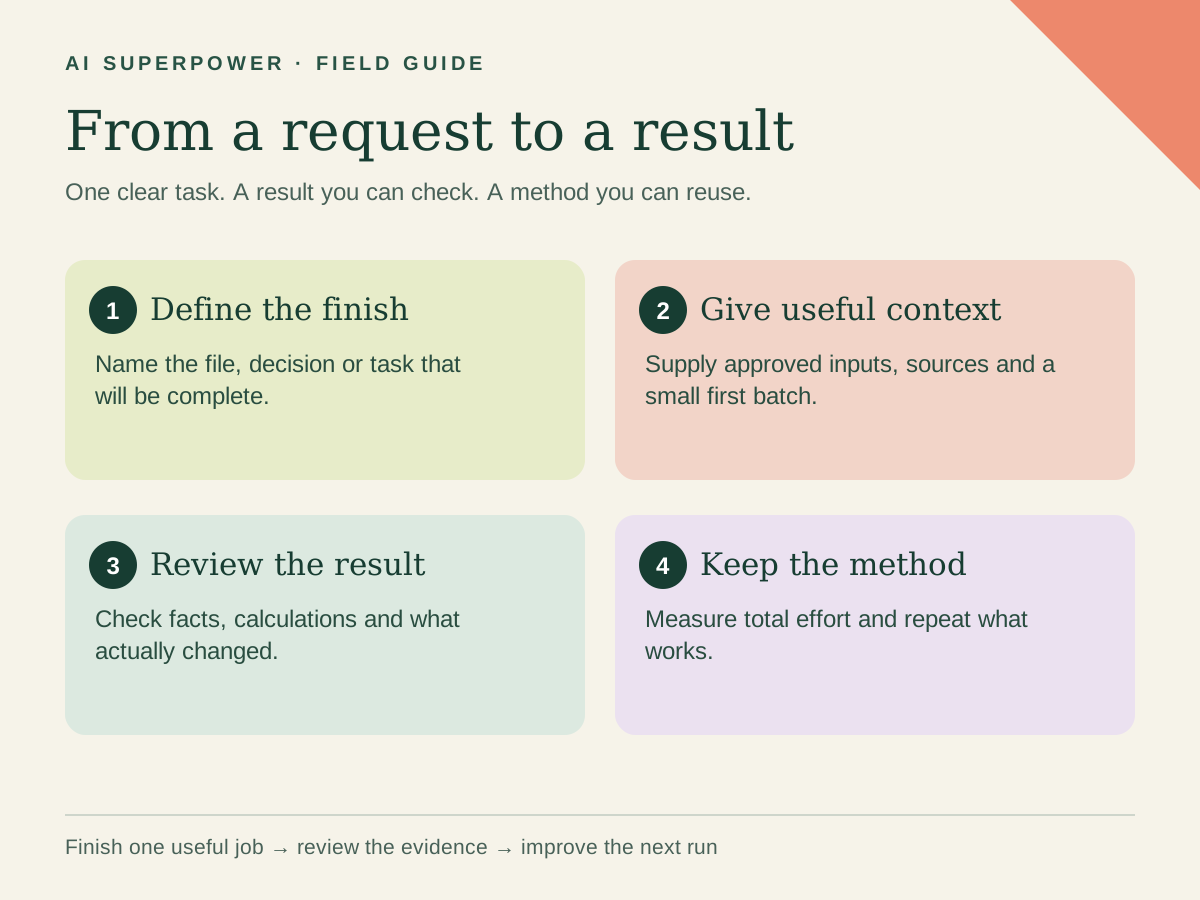
Give an agent a bounded job, approved inputs, an output format and a definition of done. Start with one workflow, check its result, and measure your total effort before expanding.
There is a satisfying difference between getting an answer and crossing something off your list. An agent workflow aims for the second: gather the relevant material, do the work, create a usable result and show what happened. The opportunity is more finished work with less repetitive handling. Whether it actually saves time depends on the task and the review it needs.
These are original practice workflows, not independently benchmarked performance claims. Choose an agent you can already access. For setup, see our Grok Bot, Claude Desktop and ChatGPT Work guides.
Start with a brief the agent can finish
A useful brief answers five questions: What will exist when the task is done? Which inputs are authoritative? What may the agent change? What should happen when something is missing? How will you check the result? Give it a small first batch so you can correct the method before repeating mistakes across a hundred records.
Outcome: create [deliverable] for [audience].
Use: [files, URLs, approved accounts and date range].
Include: [required fields, format and quality criteria].
If information is missing, label it and ask only what blocks the task.
You may: [allowed actions]. Stop before: [external action].
Return the result, sources, unresolved issues and a completion checklist.
Six jobs worth trying
1. Research that becomes a decision
Choose a real purchasing or project question. Supply five candidate vendors and three non-negotiable requirements. Request a comparison with source URLs, dates and unknowns, then a one-page recommendation. The finished result is a decision aid rather than a pile of links.
Compare these five providers against our requirements. Use official pages.
Create a table with evidence for each criterion. Mark unverified claims.
Recommend two to investigate, explaining the tradeoffs. Do not contact them.
2. A recurring report that leads to action
Provide two small approved exports with matching periods. Ask the agent to reconcile totals, calculate changes and produce three questions for your review. With fictional data, 40 inquiries and 10 bookings means a 25% inquiry-to-booking rate. A report that calls that a 10% rate needs correction before automation.
Check these exports for missing dates and duplicate rows. Calculate the
agreed metrics with visible formulas. Create a brief separating observed
changes from possible explanations. Do not change campaigns or budgets.
3. Forms prepared from one reliable profile
Use a harmless test form you control and a short approved business profile. Have the agent map every field to supplied information, fill the available fields, and list gaps. Review the complete form before authorizing submission. Check which actions actually persist: some forms save while you type.
Prepare this test form using only my approved profile. Leave unsupported
answers blank. Show the field-to-source mapping and stop before submission,
terms acceptance or any payment. Report any automatic save behavior.
4. One good source becomes a content package
Supply a source article you own, approved claims, audience and offer. Ask for an email, a social post and a six-slide outline with a consistent call to action. Compare every factual statement against the source; remove invented quotes, customer outcomes and statistics.
Turn this approved article into three formats. Preserve its meaning.
Give each format a distinct opening. Add a claim checklist with source
locations. Save editable drafts; publication is a separate decision.
5. Feedback becomes a product review
Give the agent anonymized feedback, current constraints and the question the team must decide. Ask for themes, contradictory evidence, example quotes and candidate experiments. Frequency in a small sample is not proof of market demand, and a request is not automatically a roadmap commitment.
Group this feedback by user problem. Retain record IDs, conflicting
examples and uncertainty. Suggest three small experiments with success
criteria. Do not invent customers, research findings or priority scores.
6. A web page gets a useful quality review
Choose one public page or your own test environment. Ask the agent to follow the primary journey and record broken links, confusing instructions and missing states. Request findings with reproduction steps. A concrete issue such as an unlabeled required field is more useful than “improve the UX.”
Review this page on desktop and a narrow mobile viewport if supported.
Test navigation and the primary task without sending real inquiries.
Return evidence, severity, reproduction steps and proposed fixes.
Give each tool a job
A connected app can supply structured records; a browser handles visible website interactions; file tools create deliverables. OpenAI's plugin documentation explains how installed plugins bring skills and service tools into Work. Pick the smallest access that completes your task. Several agents only help when their assignments and handoffs are clear; one person should own the final acceptance decision.
Measure finished work, including the cleanup
| Measure | Record after each run |
|---|---|
| Quality | Required facts correct, missing items, corrections needed |
| Your time | Briefing + monitoring + review + repair |
| Elapsed time | Start to accepted deliverable, including interruptions |
| Cost | Relevant subscription or usage cost |
| Decision | Keep, revise or stop—with the reason |
Compare against how you normally do the same work. Save an accepted example and test the method on a fresh input. Only then turn the process into a reusable skill; OpenAI documents skill creation, and Grok Bot documents skills and routines. Scheduling needs its own owner, timezone and failure behavior.
Pick one job for this week. The win is a reliable result you would use again. Try the Tool Trial Lab, or bring your process to a $350 AI Working Session.
Explore the Agent Field Guide → · Get help with your workflow →
Sources and further reading
Sources checked October 31, 2026. Tool features and plan availability can change; review the linked publisher documentation before connecting an account.
Put one idea to work
Compare a tool on work you understand, measure review effort, and keep the result only when it improves the task.
Plan a useful tool trial →Explore more from AI SuperpowerKeep practicing
 Technology field notes
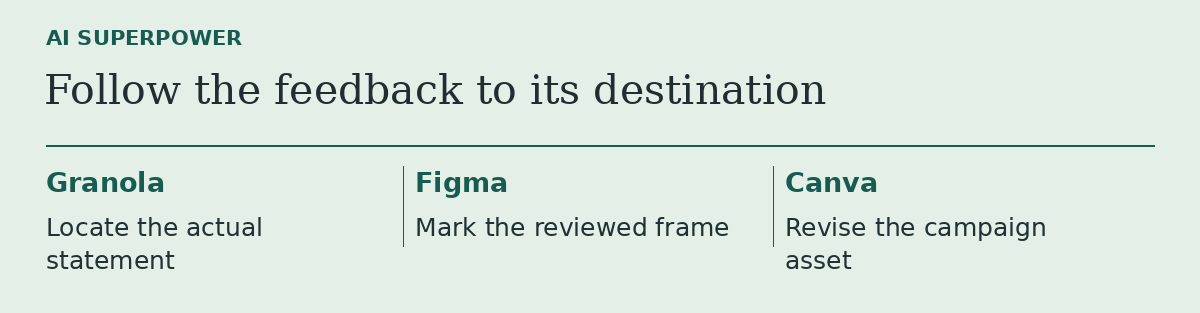
Granola, Figma or Canva? Follow one piece of feedback to the right tool
Three product updates make more sense when you start with the file you need to change.
November 18, 2026 · 2 min read Technology field notes
Before you subscribe to an AI agent, give it a task it should leave unfinished
An acceptance test for buyers who need to know what an agent does when information runs out.
November 18, 2026 · 2 min read