Automation decisions
Automation, AI workflow, or agent: which do you actually need?
Choose a simple rule, an AI-assisted workflow, or an agent by the variability of the task and the consequences of a mistake.
In this guide
- The useful starting point
- Choose by the source of variation
- Ask four questions before connecting tools
- A worked example: incoming service requests
- Test ordinary cases and bad days
- A workflow selection prompt
- Measure total usefulness
- Continue with a related guide
- Apply this with a practical template
- Hire for the operating requirement
- Questions you might be asking
- Sources and further reading
The useful starting point
Use conventional automation for stable rules, an AI workflow for a known sequence that interprets variable content, and an agent when the next step genuinely depends on discovery. Evaluate the smallest workable option first.
The word agent can make an ordinary automation sound more advanced than it needs to be. The right choice depends on what varies in the task, what the system may change, and how you will recognize a correct result.
Begin by writing one example of the job and one difficult exception. If you cannot explain the desired result, adding autonomy will make the uncertainty harder to inspect.
Choose by the source of variation
A conventional automation follows a stable rule: when an approved form arrives, create a record with mapped fields. An AI-assisted workflow adds interpretation inside a known sequence, such as drafting a summary of varied requests. An agent can choose steps and tools as it works toward a goal.
These categories can coexist. A workflow may use an AI step and still remain mostly deterministic. A chat interface does not by itself make a system agentic. Anthropic's distinction between workflows and agents is a useful starting point for evaluating the architecture.
Ask four questions before connecting tools
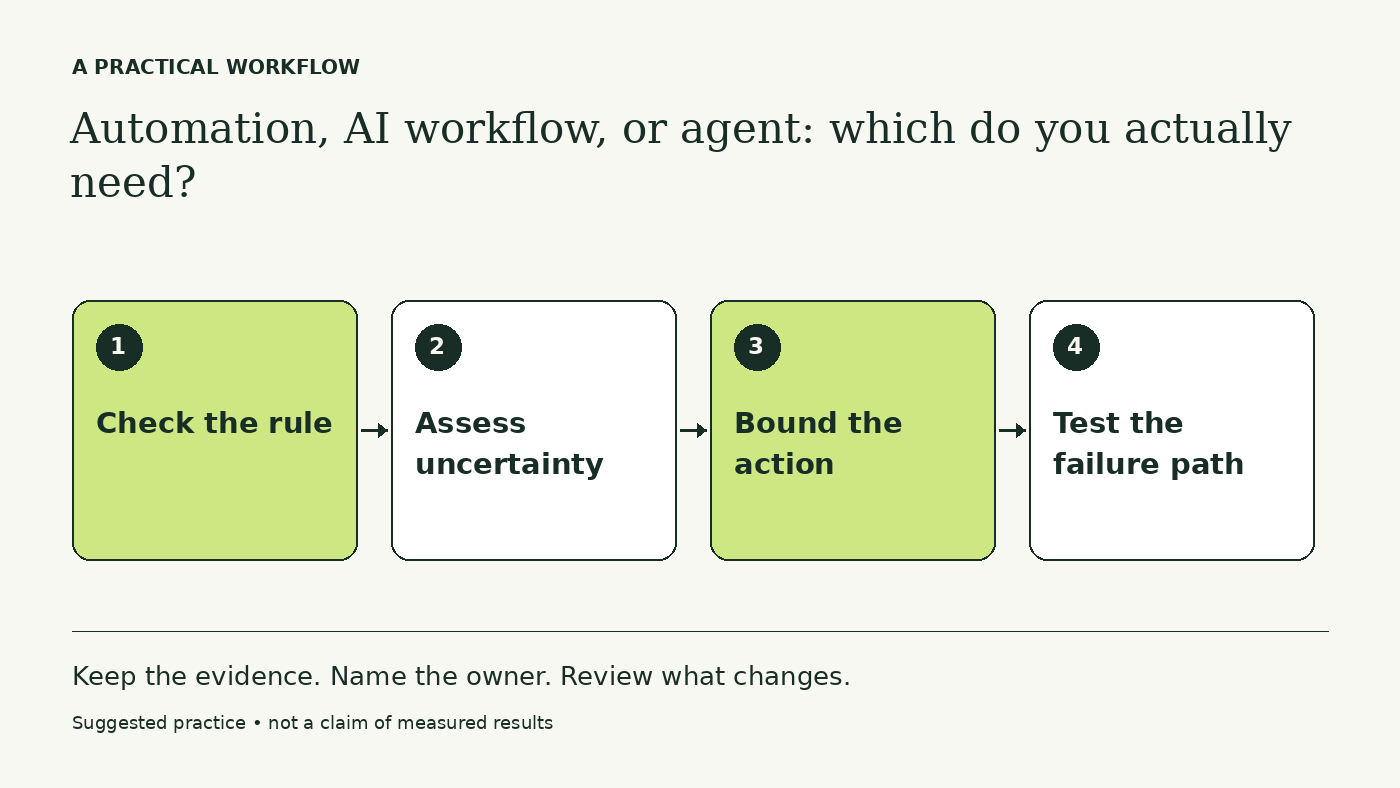
- Is the sequence known, or must the system discover the next step?
- Are the inputs structured, variable, or sometimes missing?
- Can we check the result against a reliable source or rule?
- What happens if the action is wrong, repeated, or interrupted?
The last question often determines the practical design. Creating a draft is easier to reverse than changing a customer's account. Use permissions and application controls to enforce boundaries; instructions in a prompt are not a substitute.
A worked example: incoming service requests
Imagine a hypothetical consulting business. A form collects contact details and a service category. A conventional rule can store those fields and send the record to the correct internal queue.
A free-text description may benefit from AI summarization. The workflow can draft a brief, preserve the original text, and mark missing requirements. A person decides whether the request fits the offer and what to send back.
An agent that independently researches the company, negotiates scope, and books delivery would be a much broader system. The first two steps do not establish that the business needs or can supervise that autonomy.
Test ordinary cases and bad days
Create a small evaluation set from approved examples. Include an empty field, conflicting information, duplicate events, unavailable systems, and text attempting to override instructions. Define the expected behavior before running the workflow.
Check repeated execution. If an event arrives twice, will the system create two records or send two messages? Use stable identifiers and deduplication where actions can repeat. Record partial completion so a retry does not silently repeat a successful step.
A workflow selection prompt
Compare conventional automation, a fixed AI-assisted workflow, and an agent for this task: [task and exceptions]. Explain which uncertainty each option handles, its inputs, actions, review requirements, and recovery path. Recommend the simplest adequate design. Propose test cases for missing data, duplicate events, tool failure, and misleading source text.
Measure total usefulness
Count usable results, incorrect actions, exceptions, review effort, and maintenance. Set a cost limit and an owner who can pause the workflow. A successful first pilot should make the process easier to understand as well as easier to perform.
Browse tools by the job they support, then test candidates with the same inputs and acceptance criteria. A more autonomous product is valuable only when that autonomy improves your actual work.
Continue with a related guide
- How to create your own AI team: start with one useful workflow
- How to use AI as a product manager without inventing customer evidence
Apply this with a practical template
Build your AI team with role charters, clear handoffs, and review
Hire for the operating requirement
A freelance engineer can help implement the approach you have chosen, but the brief should state what the system must do and how you will test it. Ask for evidence of reliable integrations, access controls, monitoring, and handoff. A working demo alone is not evidence that an unattended agent is ready for business use.
Affiliate disclosure: We may earn a commission if you become a qualifying Upwork customer through this link.
Explore hiring on Upwork. Compare relevant work, agree on a small paid milestone, and review the handoff. Hiring and income outcomes are not guaranteed.
Questions you might be asking
Is an AI workflow always better than a rule?
No. Stable mappings and conditions are often simpler and more predictable as conventional automation.
What should happen when the agent is uncertain?
Define an explicit fallback: ask for missing information, produce a draft, or route the case to an accountable person.
Sources and further reading
Sources checked October 16, 2026. Tool features and plan availability can change; review the linked publisher documentation before connecting an account.
Put one idea to work
Compare a tool on work you understand, measure review effort, and keep the result only when it improves the task.
Plan a useful tool trial →Explore more from AI SuperpowerKeep practicing
 Developer workflows
Migrate Shopify Storefront MCP to UCP without losing cart state
A developer checklist for endpoint discovery, catalog/cart tool mapping, agent profiles, full cart updates and checkout verification.
October 20, 2026 · 4 min read Field tests
We checked GitHub, Railway and Supabase in one publishing workflow
An observed, read-only MCP field report: what three connected tools returned, how the results agreed, and what the checks cannot prove.
October 20, 2026 · 4 min read