Field tests
We checked GitHub, Railway and Supabase in one publishing workflow
An observed, read-only MCP field report: what three connected tools returned, how the results agreed, and what the checks cannot prove.
In this guide
The useful starting point
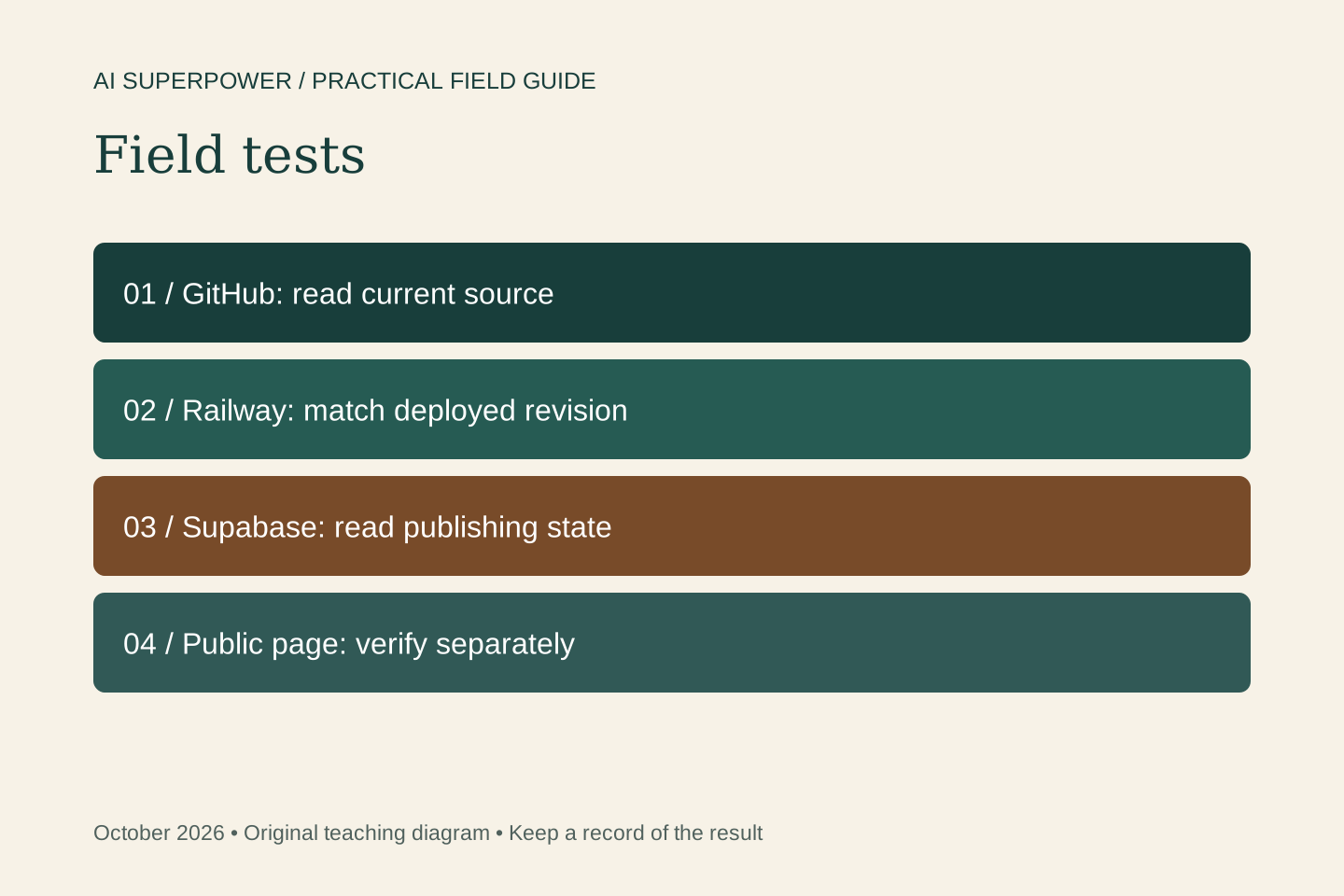
Three read-only checks returned usable evidence: GitHub exposed the current content source, Railway reported a successful deployment for the same commit, and Supabase returned the published Agency article. That establishes useful retrieval in this session, not universal reliability or write safety.
The useful question about a connection is whether it helps finish a real task. During our October 20, 2026 publishing review, we used the connected GitHub, Railway and Supabase tools to answer three bounded questions about our own sites.
Method: one ChatGPT Work session, existing authenticated connections, read-only requests, and live project records. We did not time installation, compare hosts, measure latency or test every capability. These observations describe this run, not a benchmark ranking.
What we checked and what came back
| Connection | Request | Observed result | Limit |
|---|---|---|---|
| GitHub | Read the AI Teachers main-branch reference and editorial posts file. | The branch returned a commit and the file contained the published Upwork and Shopify guide records. | Reading source does not show what a visitor receives. |
| Railway | Read the AI Teachers service's latest deployment record. | The deployment was SUCCESS and its commit matched the GitHub main-branch commit. Its UTC creation time was October 20 at 23:57. | A successful deploy does not establish every page, checkout or form works. |
| Supabase | Read the Agency CMS record for the business-tool article. | The expected title and slug were returned with site=agency and status=published. | A published row does not prove the route is uncached, public or indexed. |
The exact repository hashes, project identifiers and database row IDs remain in the private publication records. They are useful for internal reconciliation but unnecessary for readers to repeat the method on their own projects. No credentials or customer data are included here.
Why the comparison matters
Two systems can disagree without either being broken. A repository can contain a new article while hosting still serves the previous commit. A CMS row can be published while a page cache still contains an older result. The GitHub-to-Railway commit match removed one specific uncertainty in our check. The separate CMS read confirmed the Agency article's publishing state.
The outcome was a usable evidence trail for the publishing task. We make no time-saving claim because we did not measure a comparable manual process. We also did not test account setup, write permissions, rollback, transaction safety or behavior under load.
Repeat the test on your own work
- Choose one question with an independently checkable answer, such as “Which source revision is deployed?”
- Record the host, account scope, connection and requested operation. Start with a read.
- Save the relevant result fields, with secrets and personal information removed.
- Compare the result with a second authoritative record where possible.
- Open the public output separately and verify the expected title, URL and content.
- Write the limitation beside the result. Do not turn an untested capability into a pass.
A field log you can copy
| Question | What do I need to decide? |
|---|---|
| Inputs and scope | Which account, project, host and allowed operation? |
| Expected evidence | Which value or document can establish the answer? |
| Observed result | What did the tool actually return, and when? |
| Independent check | What agrees, disagrees or remains unknown? |
| Decision | Use, retry after diagnosis, or stop? |
Interpret a failure carefully
An unavailable subscription, missing permission, expired authorization or unsupported action can block a task without proving the service is down. Preserve the error category and check the prerequisite before repeating requests. If a write's outcome is uncertain, inspect current state before retrying.
Use our AI tool test bench to extend this into a repeated evaluation, or start a tool trial for one job you do every week. The practical MCP guide helps choose the job; this report shows how to keep the result honest.
Sources and further reading
Sources checked October 16, 2026. Tool features and plan availability can change; review the linked publisher documentation before connecting an account.
Put one idea to work
Compare a tool on work you understand, measure review effort, and keep the result only when it improves the task.
Plan a useful tool trial →Explore more from AI SuperpowerKeep practicing
 Developer workflows
Migrate Shopify Storefront MCP to UCP without losing cart state
A developer checklist for endpoint discovery, catalog/cart tool mapping, agent profiles, full cart updates and checkout verification.
October 20, 2026 · 4 min read Freelance work
Upwork MCP in practice: job search, proposals, bids, and portfolio evidence
A practical Upwork MCP workflow for people learning to put AI connections to work: project fit, honest proposals, bid review, portfolio evidence, and a small side-work test.
October 20, 2026 · 4 min read