AI for product managers
How to use AI as a product manager without inventing customer evidence
Use AI for research organization, opportunity framing, requirements, and experiment reviews while preserving sources and product judgment.
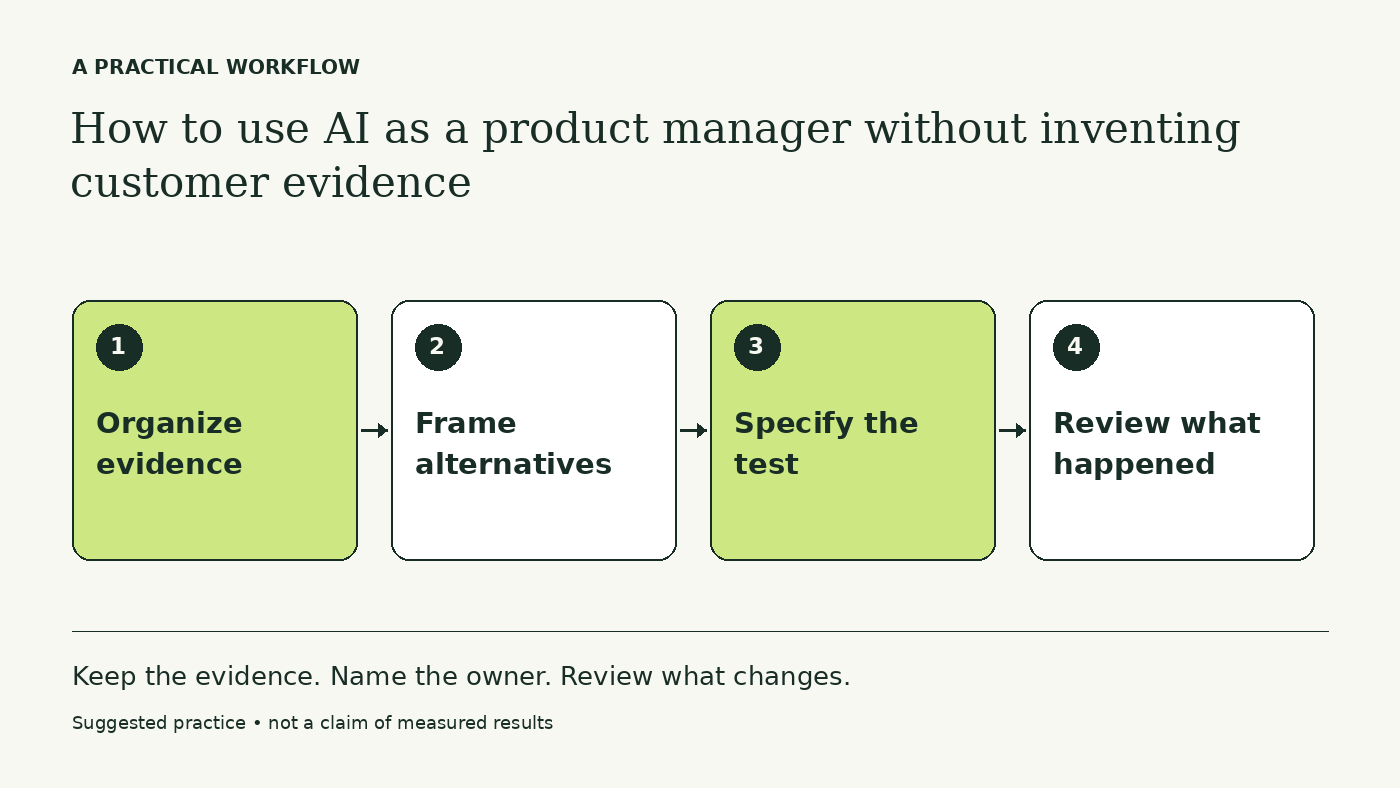
In this guide
- The useful starting point
- Organize research without manufacturing it
- Turn themes into choices
- A worked example: a difficult import step
- Draft requirements with explicit uncertainty
- A product decision prompt
- Build a reusable context packet
- Continue with a related guide
- Apply this with a practical template
- Questions you might be asking
- Sources and further reading
The useful starting point
Use AI to organize evidence, expose assumptions, draft alternatives, and check requirements. Keep customer research, prioritization, and release decisions grounded in real sources and accountable people.
Product managers spend much of their time turning incomplete information into a decision. AI can help structure that information and reveal inconsistencies. It can also make an unsupported interpretation look ready for an executive meeting.
A useful workflow keeps evidence and proposals separate. Begin with the decision you need to make, then decide what assistance would reduce the effort required to make it responsibly.
Organize research without manufacturing it
Collect approved interview notes, support themes, product events, and sales observations. Label their source and date. Ask AI to cluster themes and cite the exact source behind each one. Keep contradictory and minority observations visible.
Generated personas can support brainstorming, but they are not research participants. A simulated interview cannot validate demand. If a model proposes a customer need, record it as a hypothesis and decide how to investigate it with real people or behavior.
Turn themes into choices
Ask for alternative explanations and possible interventions. A drop-off could reflect unclear instructions, a technical error, an audience mismatch, or a task people do not need. Do not let the first plausible explanation become the roadmap.
Use a short decision brief: problem, affected group, evidence, options, assumptions, cost, and the smallest next test. The PM owns the recommendation and the tradeoffs. AI should make the unresolved parts easier to see.
A worked example: a difficult import step
Imagine a hypothetical product whose new users abandon a file import. Support notes mention formatting confusion, but the event data only shows where users stopped. AI helps organize the notes and proposes three explanations.
The PM asks engineering to inspect failures and design to observe the task with representative users. The team chooses a smaller test: clearer requirements and a sample file. It defines completion, error rate, and support contacts before launch.
Afterward, AI drafts a review using the measured results and source notes. The PM checks the numbers and notes changes in customer mix. A correlation between the change and completion is not automatically proof of causation.
Draft requirements with explicit uncertainty
AI can help turn an agreed direction into scenarios, acceptance criteria, and open questions. Include permissions, empty states, errors, recovery, and analytics. Ask engineering and design to inspect the actual requirements rather than approving a polished document by appearance.
In Scrum, the Product Owner remains accountable for product value and backlog management even when work is delegated. A PM title does not always map exactly to that accountability; clarify your team's decision rights.
A product decision prompt
Decision: [what we must decide]. Evidence: [sources with dates and identifiers]. Create a brief with observed facts, interpretations, alternative explanations, options, and assumptions. Cite each factual claim. Draft a small test with acceptance criteria and failure cases. Leave unknowns explicit. Do not invent demand, quotes, market size, or expected uplift.
Build a reusable context packet
Keep the product goal, current constraints, metric definitions, and approved decisions in a maintained packet. Version it and remove outdated material. Provide only the sources appropriate to the task and environment.
For a first tool trial, compare the AI-assisted brief with a manually prepared one. Evaluate traceability, missed counterevidence, useful questions, and total review effort. Faster writing is helpful; a better product decision is the reason to use it.
Continue with a related guide
- How to create your own AI team: start with one useful workflow
- Automation, AI workflow, or agent: which do you actually need?
Apply this with a practical template
Build your AI team with role charters, clear handoffs, and review
Questions you might be asking
Can AI prioritize the roadmap?
It can compare options using supplied criteria. People must verify the evidence, choose tradeoffs, and own the decision.
Can synthetic users validate an idea?
They can generate questions or scenarios, but they do not establish real customer needs, behavior, or willingness to pay.
Sources and further reading
Sources checked October 16, 2026. Tool features and plan availability can change; review the linked publisher documentation before connecting an account.
Put one idea to work
Compare a tool on work you understand, measure review effort, and keep the result only when it improves the task.
Plan a useful tool trial →Explore more from AI SuperpowerKeep practicing
 Developer workflows
Migrate Shopify Storefront MCP to UCP without losing cart state
A developer checklist for endpoint discovery, catalog/cart tool mapping, agent profiles, full cart updates and checkout verification.
October 20, 2026 · 4 min read Field tests
We checked GitHub, Railway and Supabase in one publishing workflow
An observed, read-only MCP field report: what three connected tools returned, how the results agreed, and what the checks cannot prove.
October 20, 2026 · 4 min read