AI teams
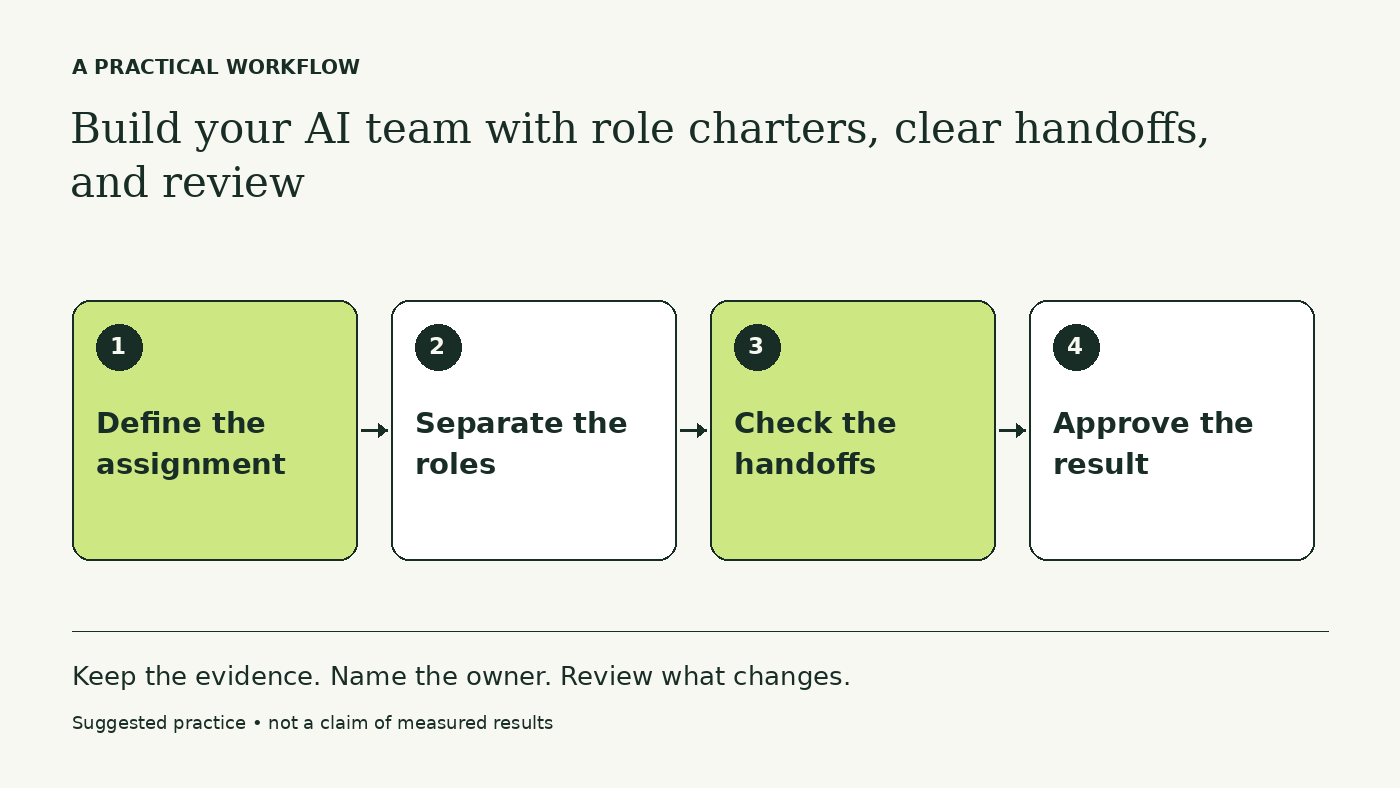
Build your AI team with role charters, clear handoffs, and review
Copy practical role briefs for an AI research assistant, planner, drafter, and reviewer without creating unnecessary agent complexity.
In this guide
- The useful starting point
- Copy the role charter
- Role one: evidence researcher
- Role two: planning assistant
- Role three: drafting assistant
- Role four: reviewing assistant
- Define the handoff before adding tools
- Test the team on familiar work
- Build on the earlier guides
- Questions you might be asking
- Sources and further reading
The useful starting point
Give each AI role a bounded task, approved inputs, required output, and clear limits. Begin with a sequence you supervise; add autonomous tool use only when it solves an observed need.
An AI team can begin as a few reusable role briefs that you run in sequence. It does not require four autonomous agents, four subscriptions, or a complicated orchestration platform. The useful distinction is between responsibilities: finding evidence, making a plan, drafting an artifact, and checking whether it meets the brief.
Start with one recurring job you understand well enough to review. A weekly customer-insight memo or an internal campaign brief is a more manageable starting point than asking an agent to run an entire business.
Copy the role charter
- Purpose: What specific contribution does this role make to the workflow?
- Inputs: Which sources may it use, and what context must accompany them?
- Output: What artifact, structure, and evidence references must it return?
- Limits: Which decisions or actions are outside its authority?
- Escalation: What missing information, conflict, or failure should stop the task?
- Acceptance: What will the human reviewer check before the work moves on?
Use these fields for human responsibilities too. The person who owns the outcome needs to be identifiable even when multiple tools contribute to it.
Role one: evidence researcher
From these approved sources, extract observations relevant to the assignment. Attach a source and date to each observation. Separate direct evidence from interpretation. List contradictions and missing information. Do not invent customer quotes, statistics, or source references. Return an evidence table and questions for the owner.
Check the references yourself. A source URL that exists is not enough: it must support the adjacent claim. If the task requires current information and the tool cannot access it, the output should state that limitation instead of filling the gap from memory.
Role two: planning assistant
Use the reviewed evidence and this objective to propose a short plan. For each step, name the required input, expected output, dependency, and decision for the human owner. Explain which assumptions remain unresolved. Offer a smaller alternative if the evidence does not support the full plan.
The planner can suggest sequencing. It cannot commit another person's time, spend money, or approve a public release merely because a plan lists those actions.
Role three: drafting assistant
Produce the requested artifact using the approved plan and evidence. Preserve source references for factual claims. Mark any section that requires missing information. Follow the audience, tone, and length requirements. Return the draft and a short list of unresolved choices.
Keep the original inputs available at this stage. Passing only an earlier model's summary can amplify a misunderstanding and make it harder to discover where the mistake began.
Role four: reviewing assistant
Check this draft against the original assignment and evidence. Identify unsupported claims, missing requirements, contradictions, and unclear passages. Cite the exact passage and explain the issue. Distinguish necessary corrections from optional preferences. Do not assume that the earlier assistants are correct.
This review can reveal problems, but another model's agreement is not independent proof. A human should inspect the important claims, calculations, permissions, and final action. For numerical work, use a suitable calculator or code-based check rather than treating confident prose as verification.
Define the handoff before adding tools
Each output should include its version, source references, unresolved questions, and the next person's responsibility. Decide what happens when an input is absent. A clear stop with a specific question is often more useful than an elaborate answer built on a guess.
If you connect tools, separate read access from write access. Explicitly define which actions require approval, such as sending messages or publishing changes. Review those permissions for the actual workflow instead of assuming a role name creates an access boundary.
Test the team on familiar work
Run the same small assignment through the sequence and through your usual process. Compare useful quality, total review effort, time, and tool cost. Include a case with conflicting evidence and one with missing inputs. Keep the roles that help and combine those that create needless handoffs.
Anthropic's workflow patterns provide a useful conceptual foundation. These role charters are original templates for applying a simple sequence, not a claim that more agents automatically produce better work.
Build on the earlier guides
- How to create your own AI team: start with one useful workflow
- How to use AI as a product manager without inventing customer evidence
- Automation, AI workflow, or agent: which do you actually need?
Questions you might be asking
Do I need a separate model for every role?
No. You can run the roles in separate conversations or stages with one suitable tool. Preserve the original brief and evidence between stages.
Does the reviewer make the output trustworthy?
It provides another check, not a guarantee. Verify important sources and calculations and keep a human accountable for consequential actions.
Sources and further reading
Sources checked October 16, 2026. Tool features and plan availability can change; review the linked publisher documentation before connecting an account.
Put one idea to work
Compare a tool on work you understand, measure review effort, and keep the result only when it improves the task.
Plan a useful tool trial →Explore more from AI SuperpowerKeep practicing
 Developer workflows
Migrate Shopify Storefront MCP to UCP without losing cart state
A developer checklist for endpoint discovery, catalog/cart tool mapping, agent profiles, full cart updates and checkout verification.
October 20, 2026 · 4 min read Field tests
We checked GitHub, Railway and Supabase in one publishing workflow
An observed, read-only MCP field report: what three connected tools returned, how the results agreed, and what the checks cannot prove.
October 20, 2026 · 4 min read