Agents and workflows
How Claude prompts and Grok Bot agent teams actually work
Understand prompt engineering, agent workflows and harness engineering. Learn what Grok Bot supports and how to test an AI system before relying on it.
In this guide
- The useful starting point
- Understand the different pieces
- Better prompting starts with the result you need
- What Grok Bot officially supports
- What harness engineering adds
- Give each agent an output that another person can inspect
- Test a bounded assignment before scheduling it
- Check the controls that sit outside the conversation
- Sources and further reading
The useful starting point
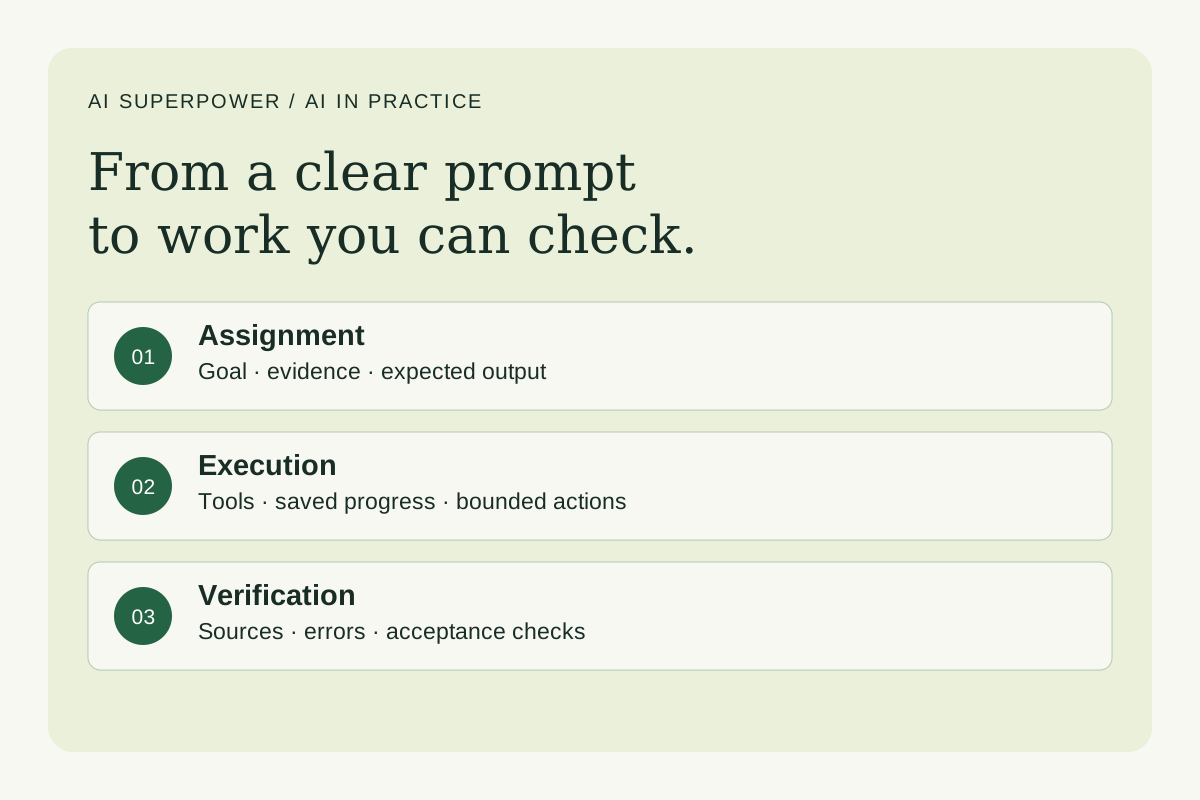
A prompt defines the assignment. The agent system adds tools and decisions, while its harness manages execution, saved progress and controls. Test those pieces on a bounded task before scheduling or expanding the work.
An AI assistant can give you an answer, prepare a document or work through a task using connected tools. Those experiences depend on different parts of the system.
A prompt tells the model what you want. The surrounding software determines what it can access, which actions it can take and how work continues after an interruption. Understanding both helps you evaluate claims about AI teams that work around the clock.
You do not need a private prompting playbook to learn the basics. Anthropic publishes prompting guidance and engineering accounts, and Grok Bot has public documentation describing its operating environment. Those sources give you a firmer starting point than a promotional post.
Understand the different pieces
| Term | Plain meaning | Example |
|---|---|---|
| Prompt engineering | Improving the instructions you give the model | Specify the audience, source material and report format |
| Context engineering | Deciding what information is available at each step | Supply the current brief and the relevant evidence |
| Workflow | A defined sequence of steps | Research, draft, check and approve |
| Agent | A system in which the model chooses actions and tools toward a goal | Follow a useful research lead and decide what to inspect next |
| Agent harness | Software that manages execution around the model | Run tools, save task state, apply controls and record results |
| Multi-agent system | Several agents with divided responsibilities | Separate researchers report to a coordinator |
Anthropic distinguishes predefined workflows from agents that direct their own process. [1] The other descriptions here are practical working definitions; product vendors do not always use these labels consistently.
Better prompting starts with the result you need
For a useful prompt, specify the task, the evidence available and the form of the answer. Include an example when it clarifies your expectations. Anthropic's documentation covers explicit instructions, context and examples. [2]
For example, replace “Research my competitors” with an assignment such as: “Compare the public service pages of these three businesses. Return the stated customer, deliverable, listed price and source URL. Label missing details as unknown. Suggest two positioning questions for me to investigate.”
That prompt does not establish which competitor is successful. It sets a narrower task the assistant can support with visible evidence.
Decide how you will evaluate the answer before you refine the wording. Anthropic's prompting overview explicitly begins with success criteria and ways to test them. [3] In this example, you can open the cited pages and check whether the table accurately represents them.
What Grok Bot officially supports
Grok Bot's documentation describes persistent cloud computing, tools and collaboration between Bots. Work can continue when the user's laptop is closed, and Bots can coordinate in parallel. [4]
The same documentation makes an important distinction: a user's Bots share a cloud computer, including files, browser sessions and app logins. Separate names and roles do not create separate security environments. [4]
Those capabilities support real task delegation. They do not establish the results of a particular viral demonstration, or prove that an arbitrary team of twenty agents will deliver reliable work. Continuous availability and successful completion are different claims.
Confirm current access, limits and integrations in the official documentation and your account before designing around them. A product's API features and its consumer app features should not be assumed to be identical.
What harness engineering adds
Consider a research assignment that spans several sessions. The assistant needs to know which sources were checked, what remains uncertain and where the current draft lives. It also needs a reliable way to resume the next action.
In its published work on long-running agents, Anthropic describes setting up the environment, making incremental progress and leaving records for subsequent sessions. [5] Harness engineering deals with the surrounding machinery that helps this happen consistently.
Here is an original practical checklist for evaluating that machinery:
- The task has a current record showing its owner, status and required output.
- The agent can access the sources and tools the assignment requires.
- Tool results and errors are recorded so you can inspect what happened.
- Work can resume without repeating completed external actions.
- Limits define how long the task may run and what it may spend.
- The final result is checked against the original assignment.
You can imitate part of this structure manually with a document and checklist. Automatic enforcement requires software support. A prompt asking for a spending cap cannot guarantee that every connected service enforces it.
Give each agent an output that another person can inspect
A proposed small research team could divide responsibilities this way:
| Role | Responsibility | Required output |
|---|---|---|
| Coordinator | Define the question and assign separate topics | Task list with scope and ownership |
| Researcher | Inspect sources for one assigned topic | Findings with URLs and unresolved questions |
| Reviewer | Check the findings against the sources | Specific errors and missing evidence |
| Human owner | Decide how the work will be used | Acceptance, corrections or a new question |
These are suggested responsibilities, not a claim that the product automatically creates or enforces this organization. You can combine roles for a small task.
Anthropic's account of its multi-agent research system describes a lead agent delegating work to subagents. It also reports added coordination demands and higher token usage. [6] Multiple agents are worth testing when the work can be separated, and the expected benefit justifies that overhead.
For example, separate researchers can inspect different markets. A team drafting one tightly connected paragraph may spend more effort reconciling differences than doing useful work.
Test a bounded assignment before scheduling it
Use this original prompt for a low-risk trial:
Review these three official product documentation pages for the features listed in my brief. Save a comparison table with one source link per factual claim. Identify unavailable pages and uncertain details.
Work on the supplied feature list only. Use one researcher unless you can identify independent research tasks that need separate workers. Keep a record of what was checked and what remains.
Return the comparison, unresolved questions and a short account of the checks performed. Do not purchase tools, send messages or change account settings. Stop if a required page needs access I have not provided.
Then inspect both the output and the process. Did it use the specified sources? Did it preserve uncertainty? Did it stay within the assignment? Could you identify where a mistake entered the work?
Introduce a missing page or conflicting detail in a later test. An assistant that reports the gap accurately is more useful than one that silently fills it in.
Check the controls that sit outside the conversation
For scheduled or consequential work, inspect the actual tool permissions, execution limits and approval settings. Ask how the system prevents duplicate actions after a retry and how you stop a run.
Grok Bot documents skills for reusable procedures and routines for recurring work. [7] Its ability to schedule work is useful only after you have decided what the routine should do and how you will know whether it succeeded.
Choose a tool by the job you need done: the required integrations, the quality of its output and the evidence you can inspect. Compare candidates on the same small assignment before expanding their responsibilities.
Use AI Superpower as a starting point for exploring AI tools, then verify product capabilities in the vendor's current documentation. If you want help shaping and testing one real task, explore an AI Working Session with Ashley.
Sources and further reading
- [1] Anthropic — Building effective agents
- [2] Anthropic — Prompting best practices
- [3] Anthropic — Prompt engineering overview
- [4] Grok Bot — Official overview
- [5] Anthropic — Effective harnesses for long-running agents
- [6] Anthropic — How we built our multi-agent research system
- [7] Grok Bot — Skills and routines
Sources checked October 23, 2026. Tool features and plan availability can change; review the linked publisher documentation before connecting an account.
Put one idea to work
Compare a tool on work you understand, measure review effort, and keep the result only when it improves the task.
Plan a useful tool trial →Explore more from AI SuperpowerKeep practicing
 Workflow design / Steal my stack
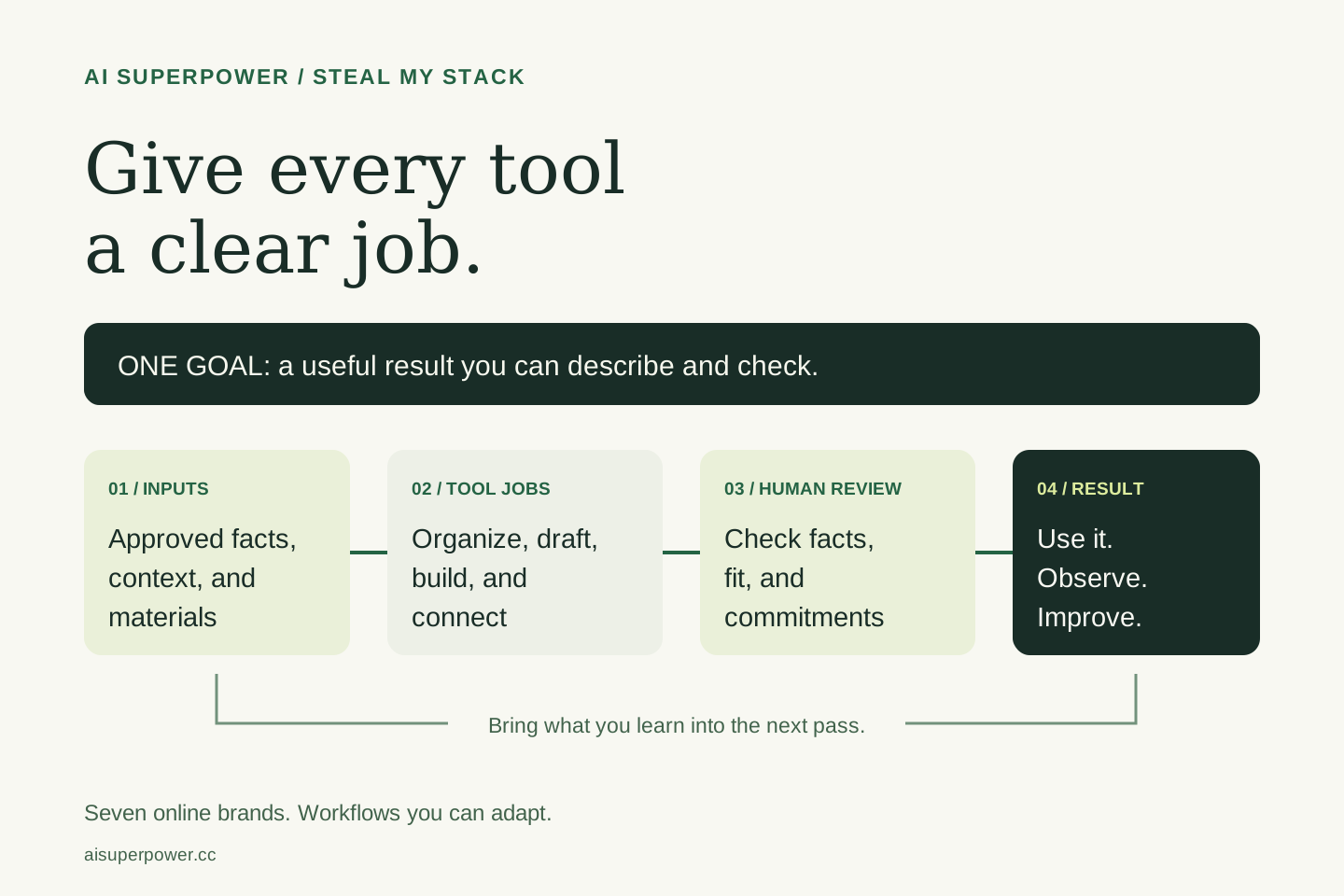
Steal my stack: give every AI tool a clear job
Borrow the workflow thinking behind seven online brands. Map the task, inputs, tools, handoffs, and human checkpoints before adding another app.
October 23, 2026 · 6 min read Video workflows
Give Claude five jobs on your next YouTube video
Use Claude to plan a YouTube video, develop titles and thumbnails, write editing briefs, organize review notes, and select useful clips with five reusable prompts.
October 23, 2026 · 8 min read